Green coffee becomes a different material
Green coffee is the dried, unroasted seed prepared for trade. Roasting changes its color, structure and aroma through heat-driven physical and chemical changes. It is not simply making an already finished bean darker.
Color names such as light, medium and dark help describe a seller's range, but they are not identical across roasters. The chosen coffee, roast progression and final brew all affect the cup. “Espresso roast” describes an intended use, not a separate botanical type.
Evidence: NCA: roast descriptions · WCR varieties catalog
Decide whether your setup is ready
Read the current manual for the exact roaster and regional electrical model before buying green coffee for it. The Behmor 2000AB manual, for example, warns that coffee can ignite and requires attendance throughout use. It also distinguishes its temperature sensors from actual bean temperature.
A suitable setup must follow the maker's location, clearance, electrical, batch-size, ventilation, cooling and cleaning requirements. Smoke suppression does not mean there is no smoke or fire risk. Do not disable an alarm or safety interlock to make a setup convenient.
- You have a purpose-built roaster, the correct regional model and its complete current manual.
- Your location meets its clearance and ventilation instructions without exposing others to smoke.
- You can remain present throughout roasting and cooling, with children and pets kept away from hot equipment.
- You know the manual's shutdown and emergency response before starting.
- You can remove chaff and perform permitted cleaning at the specified intervals.
- If any requirement is unclear, resolve it with the manufacturer before roasting.
Understand the stage names
These are observation categories, not a heat program. Transitions overlap, and the timing and sensor readings depend on coffee, batch and equipment.
| Stage or event | What to observe | What to avoid assuming |
|---|---|---|
| Drying and early heating | Changes from green toward yellow, with moisture being driven off. | One universal minute or displayed temperature marks the end. |
| Browning | Color and aroma change as roasting reactions progress. | A darker surface alone proves uniform development. |
| First crack | A series of audible pops associated with structural expansion. | All beans crack together, or every sensor measures bean temperature. |
| Development and finish | Continued changes after the observed crack, until the chosen stop. | A fixed development percentage guarantees sweetness or quality. |
| Cooling | The roaster's prescribed cooling stage removes heat. | Ending heat means the beans are already safe to handle. |
| Rest and tasting | Gas release and flavor change after roasting; compare at recorded intervals. | Every coffee peaks on the same calendar day. |
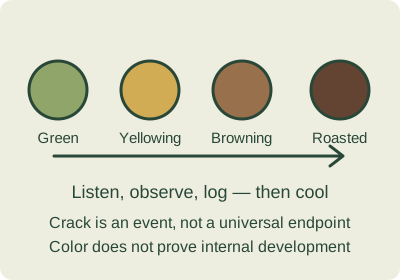
Evidence: Behmor 2000AB 120V manual, V30, 21 October 2024 · Research on coffee freshness and packaging
Choose and store the unroasted coffee
Buy green coffee explicitly sold for roasting from a specialist supplier, or ask a local roaster whether it sells small green lots. Sweet Maria’s green-coffee FAQ describes both routes. Its account is a supplier’s own guidance, not an independent ranking of sellers. Ask for the lot name, origin, processing method, available harvest or arrival information, and storage instructions; keep those details for your roast log.
For green beans, start with the supplier’s packaging advice. Sweet Maria’s storage guide favors moisture-barrier packaging or glass and a cool, dark location with stable conditions, away from excessive humidity and heat. A decorative cloth sack is not a substitute for a protective inner container. Close the package after taking a batch out, keep it away from strong odors, and label each lot so that an unknown mix does not undermine your experiments.
Inspect the beans and package before use. Coffee Bean Corral’s storage guidance advises discarding coffee with mold, water damage, pests or strong foreign odors, rather than attempting to repair it by roasting. Looking and smelling normal does not certify safety. If a delivery is suspect, set it aside and contact the supplier.
There is no universal green-bean freshness deadline here. Initial condition, packaging, climate and handling differ. Buy an amount suited to your permitted batch size and likely practice schedule, retain the supplier’s care instructions, and record storage conditions alongside later taste observations. A roast date belongs to the finished roasted batch; it is not the green coffee’s harvest date.
- Before ordering: identify the lot, check that the roaster permits it, and ask how that particular packaging should be stored.
- On arrival: retain the label, inspect the packaging, and assign a clean, dry storage place away from heat and odors.
- Before each roast: inspect the portion, record the lot and green mass, and follow the exact machine’s operating and cooling instructions.
Evidence: Sweet Maria’s: Green Coffee FAQ · Sweet Maria’s: roasted and green coffee storage · Coffee Bean Corral: green coffee condition and storage
Use the maker's operating plan, then observe
Use the green-coffee sourcing and storage checks before ordering. Choose a documented lot that the roaster manual permits, then retain its identity and supplier care instructions for the experiment.
Use the manufacturer's beginner batch and procedure. Keep its safety limits separate from a roast preference. Do not borrow a time, heat setting or second-crack endpoint from another machine because the batch mass looks similar.
This guide does not provide an oven, pan or modified popcorn-device procedure. For an operational roast recipe, use the selected machine's validated instructions and seek competent roasting guidance if the process is unfamiliar.
Keep an observation log you can learn from
The example below is fictional. It shows the distinction between recording events and prescribing targets; its times are not instructions to run a roaster.
| Field | Example observation |
|---|---|
| Coffee | Sample A, supplier lot number recorded; washed process. |
| Equipment and batch | Exact model and regional version; batch within its manual's beginner guidance. |
| Program and environment | Maker's named beginner program; room conditions and supply noted. |
| Color change | Yellowing observed at 4:40 elapsed; uncertain transition, not a target. |
| First crack | First clear pops heard at 8:10; sustained sequence later. |
| Stop and cooling | Cooling started at 9:25 using the manufacturer's control; full prescribed cycle completed. |
| Mass | 100 g green to 85 g cooled roasted coffee: illustrative 15% mass loss. |
| Taste checks | Dates, rest interval, same brew recipe, and notes such as sharp, sweet, drying or smoky. |
| Next experiment | One permitted change and the reason for testing it. |
Compare without inventing a defect diagnosis
A smoky or scorched impression can suggest a roasting issue, but an unpleasant cup can also reflect brewing, storage or the original coffee. Record the sensation before attaching a technical defect label. Uneven surface color alone does not tell the whole story.
For a small comparison, split one suitable green lot into two manufacturer-approved batches and change one permitted variable. Brew both with the same method after recorded rest intervals. If you cannot identify a consistent preference, repeat before drawing a conclusion.
Keep a purchase option open too. Buying well-documented roasted coffee can be the better fit when ventilation, attention or equipment requirements make home roasting impractical.
Evidence: WCR Sensory Lexicon · Behmor 2000AB 120V manual, V30, 21 October 2024
Follow a practical home-roasting learning path
Start with equipment and capacity choice, then use real first- and second-crack references before operating a machine. Follow the exact-manual first-batch workflow for the model it describes; retain the manufacturer’s full diagrams and warnings.
After prescribed cooling, use the roast-log worksheet and controlled comparison. If the result is uneven, smoky, sharp or inconsistent, use the observation-based troubleshooting path. The separate guides distinguish an equipment problem from a sensory hypothesis.
Sources & limitations
This guide combines source-based explanations and practical starting points. Coffee Jacob has not performed hands-on product testing or controlled tasting trials for this guide. Source check: 13 October 2026.